





When planning your retirement savings in the United States, understanding the difference between Roth and Traditional IRA is one of the most important financial decisions you can make. Both accounts offer tax advantages that help your investments grow over time, but they work in very different ways. By learning the difference between Roth and Traditional IRA, you can choose the right retirement strategy that matches your income.
- What Is an IRA?
- What Is a Traditional IRA?
- What Is a Roth IRA?
- The Main Difference Between Roth and Traditional IRA
- Roth vs Traditional IRA Example
- Contribution Limits for IRA Accounts
- Income Limits for Roth IRA Contributions
- Traditional IRA vs Roth IRA vs 401(k)
- Types of Roth IRA Investments
- Rules for Roth IRA Withdrawals
- Which IRA Is Better for You?
- Common Mistakes When Choosing an IRA
- Final Thoughts
If you choose the right account based on your financial situation, you can significantly reduce taxes and grow your retirement savings more efficiently.
In this guide, you will learn how each account works, the main differences between them, and how to decide which option may fit your long-term financial goals.
What Is an IRA?
Before exploring the difference between Roth and traditional IRA, you should first understand what an Individual Retirement Account (IRA) actually is.
An IRA is a tax-advantaged investment account designed to help individuals save for retirement. Instead of relying only on employer-sponsored plans like a 401(k) plan, an IRA allows you to invest independently.
Inside an IRA, you can typically invest in:
- Stocks
- Bonds
- Exchange-traded funds (ETFs)
- Mutual funds
These investments grow over time while receiving certain tax benefits.
According to guidance from the Internal Revenue Service, both Roth and Traditional IRAs have annual contribution limits and specific eligibility rules.
What Is a Traditional IRA?
A Traditional IRA is a retirement account that allows you to contribute pre-tax income. This means the money you deposit may reduce your taxable income for the year.
For example, if you contribute $6,500 to a Traditional IRA and qualify for the deduction, your taxable income decreases by the same amount.
However, there is an important trade-off. When you withdraw money during retirement, the funds are taxed as ordinary income.
Key Features of a Traditional IRA
A Traditional IRA offers several benefits for investors:
- Contributions may be tax-deductible
- Investments grow tax-deferred
- Lower taxable income during working years
However, withdrawals in retirement are taxed.
Additionally, Traditional IRAs require Required Minimum Distributions (RMDs) beginning at age 73.
This means you must start withdrawing money even if you do not need it.
What Is a Roth IRA?
A Roth IRA works differently from a Traditional IRA.
Instead of receiving a tax deduction today, you contribute money that has already been taxed. In exchange, your withdrawals during retirement can be completely tax-free.
This feature makes Roth IRAs extremely attractive for investors who expect higher tax rates in the future.
Key Benefits of a Roth IRA
Some of the main advantages include:
- Tax-free withdrawals in retirement
- No required minimum distributions during your lifetime
- Flexible withdrawal rules for contributions
- Long-term tax-free growth potential
Because contributions are made with after-tax income, there is no immediate tax deduction.
However, the long-term tax benefits can be significant.
The Main Difference Between Roth and Traditional IRA
The biggest difference between Roth and traditional IRA comes down to taxes.
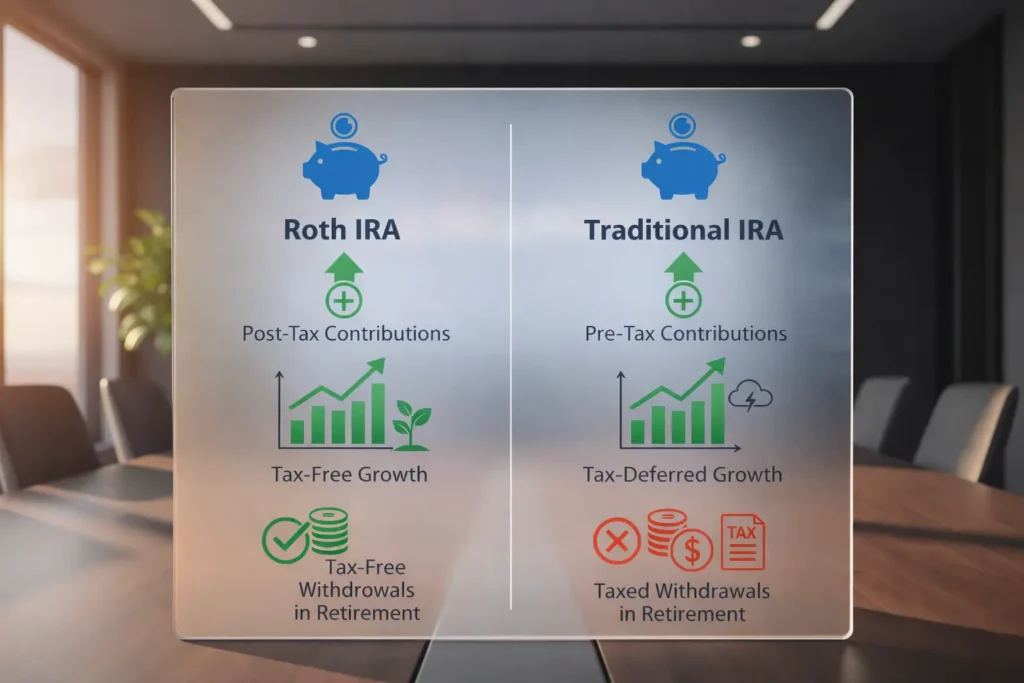
Traditional IRA contributions may reduce your taxes today, while Roth IRA contributions may eliminate taxes in retirement.
Here is a simple comparison:
Traditional IRA
- Contributions may be tax-deductible
- Taxes paid during retirement withdrawals
- Required minimum distributions apply
Roth IRA
- Contributions made with after-tax income
- Withdrawals are tax-free in retirement
- No required minimum distributions
The choice depends largely on whether you prefer a tax break now or later.
Roth vs Traditional IRA Example
To understand the difference between Roth and traditional IRA, consider a practical example.
Imagine you invest $6,000 per year for 30 years and your investments grow at an average annual return of 7%.
After three decades, your retirement account could grow to approximately $566,000.
If this money is inside a Traditional IRA, withdrawals will be taxed as income.
If it is inside a Roth IRA, you may withdraw the entire amount tax-free, provided you follow IRS rules.
This difference can result in tens of thousands of dollars in tax savings.
Contribution Limits for IRA Accounts
The IRS sets annual contribution limits for IRAs.
For most investors, the contribution limit is:
- $7,000 per year (for individuals under age 50)
- $8,000 per year (for individuals age 50 or older)
These limits apply across all IRA accounts combined.
If you contribute to both a Traditional IRA and a Roth IRA, the total cannot exceed the annual limit.
For official updates, you can review the retirement contribution rules published by the Internal Revenue Service.
Income Limits for Roth IRA Contributions
Unlike Traditional IRAs, Roth IRAs have income restrictions.
If your income exceeds certain thresholds, you may not be eligible to contribute directly to a Roth IRA.
High-income investors sometimes use strategies like the backdoor Roth IRA to bypass these restrictions.
Financial education platforms such as Investopedia provide detailed explanations of these strategies.
However, it is always wise to consult a financial professional before implementing advanced tax strategies.
Traditional IRA vs Roth IRA vs 401(k)
Many investors also compare IRAs with employer-sponsored plans such as a 401(k).
Each account type serves a different role.
401(k)
- Offered through employers
- Higher contribution limits
- Possible employer matching contributions
Traditional IRA
- Tax deduction may apply
- Taxed during retirement withdrawals
Roth IRA
- No tax deduction today
- Tax-free withdrawals later
Many investors combine multiple retirement accounts to maximize tax efficiency.
For example, you might contribute to your employer’s 401(k) while also funding a Roth IRA for tax diversification.
Types of Roth IRA Investments
Once you open a Roth IRA, you can invest in many different assets.
Common investment options include:
- Index funds
- ETFs
- Dividend stocks
- Bond funds
Choosing diversified investments can help reduce risk while growing your retirement portfolio.
Many investors favor low-cost index funds because they provide broad market exposure with minimal fees.
Rules for Roth IRA Withdrawals
Although Roth IRA withdrawals can be tax-free, certain conditions apply.
To withdraw earnings tax-free, you must:
- Be at least 59½ years old
- Have held the account for at least five years
However, you can withdraw your original contributions at any time without taxes or penalties.
This flexibility makes Roth IRAs unique among retirement accounts.
Which IRA Is Better for You?
The best choice depends on your financial situation and tax expectations.
A Traditional IRA may be better if:
- You want a tax deduction today
- Your current tax rate is higher than expected retirement tax rates
A Roth IRA may be better if:
- You expect higher taxes in the future
- You want tax-free retirement income
- You prefer avoiding required minimum distributions
Many investors diversify by holding both account types.
Common Mistakes When Choosing an IRA
When selecting between these accounts, investors often make several mistakes.
Some focus only on short-term tax savings instead of long-term retirement income.
Others ignore income eligibility rules or contribution limits.
You should also avoid withdrawing retirement funds early unless absolutely necessary, since penalties and taxes can significantly reduce your savings.
Final Thoughts
Understanding the difference between Roth and traditional IRA can significantly improve your retirement planning strategy.
Both accounts provide valuable tax advantages, but they work in opposite ways.
Traditional IRAs provide tax deductions today and taxable withdrawals later.
Roth IRAs require after-tax contributions but reward you with tax-free income in retirement.
Your choice should depend on your current tax bracket, future expectations, and long-term financial goals.
If you want to continue learning about retirement planning, investment strategies, and wealth building, explore more practical investing guides on Financgate.com.
The earlier you start investing for retirement, the more powerful compounding becomes. Your future financial security depends on the decisions you make today.